Architectural Polyurea Waterproofing and Seismic Coating
Roof, Floor, and Exterior Wall Waterproofing and Seismic-Resistant Coatings
This is a highly durable, waterproof, and seismic-resistant coating applied to building rooftops, roofs, floors, and exterior walls.
Why do buildings need waterproofing reapplied every few years?
Urethane and epoxy waterproofing are vulnerable to moisture and UV rays, requiring reapplication within 3-5 years.
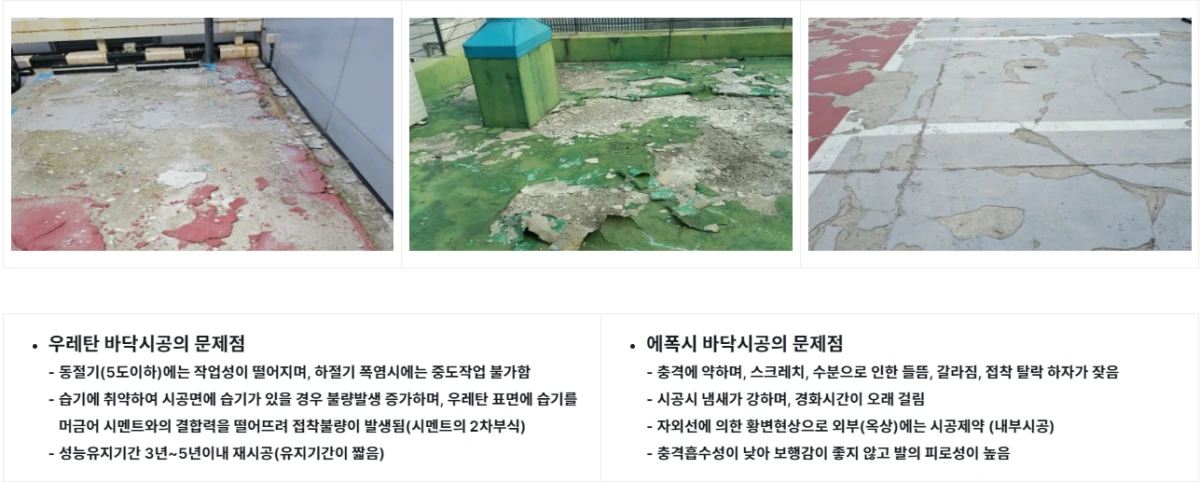
Recurring defects in existing floor and waterproofing applications stem from material limitations. Below are defects commonly observed in urethane and epoxy applications.
Problems with Urethane Floor Applications
- Workability decreases in winter (below 5 degrees Celsius), and intermediate work is impossible during summer heatwaves.
- Vulnerable to moisture, increasing defect occurrence if the application surface is damp. Moisture absorbed by the urethane surface reduces adhesion to cement, leading to bonding failures (secondary corrosion of cement).
- Requires reapplication within 3-5 years of performance lifespan (short lifespan).
Problems with Epoxy Floor Applications
- Weak against impact, frequently leading to scratches, delamination due to moisture, cracking, and adhesion failure.
- Strong odor during application and long curing time.
- Yellowing due to UV rays restricts outdoor (rooftop) applications (suitable for indoor applications).
- Low shock absorption results in poor walking comfort and high foot fatigue.
What Makes Polyurea Waterproofing Different?
It cures within 10 seconds and maintains performance 3-5 times longer than epoxy or urethane.
Polyurea can be applied in a wide range of areas, including building rooftops, roofs, floors, exterior walls, waterproofing, and seismic design for structures. Polyurea is the most efficient and effective material for unique building designs, complex construction conditions, and challenging site environments.
Polyurea's waterproofing function offers a performance lifespan 3-5 times longer than traditional epoxy and urethane, and it demonstrates overwhelming performance in moisture and vapor transmission tests.
Furthermore, it exhibits no performance changes due to UV or temperature fluctuations, making it suitable as an exterior building material, and its excellent insulation properties increase building energy efficiency. With overwhelming tensile strength and elongation, when applied to buildings, it acts as a seismic-resistant material capable of protecting structures even against Richter scale 7.0 impacts.
6 Advantages of Polyurea
| Category | Description |
|---|---|
| Ultra-Fast Curing | Cures within 10 seconds, allowing vehicle traffic within 30 minutes (effective for reducing labor costs and construction time). |
| High Tensile Strength | Possesses approximately 10 times the tensile strength of general urethane, making it suitable for environments requiring high performance in terms of impact resistance, abrasion resistance, and durability. |
| Eco-Friendly Method | Completely free of volatile organic compounds, ensuring safety for both workers and clients. |
| Strong Performance Against UV and Weathering | No deformation from UV rays, and no performance changes like shrinkage or expansion at high or low temperatures, leading to fewer defects. |
| Excellent Chemical Resistance and Waterproofing | Superior chemical resistance and waterproofing, resulting in a performance lifespan 3-5 times longer than urethane or epoxy. |
| High Hardness, High Elongation | Impact-resistant yet flexible, it does not crack or break, making it excellent for preventing fissures. |
Where Can It Be Applied in Buildings?
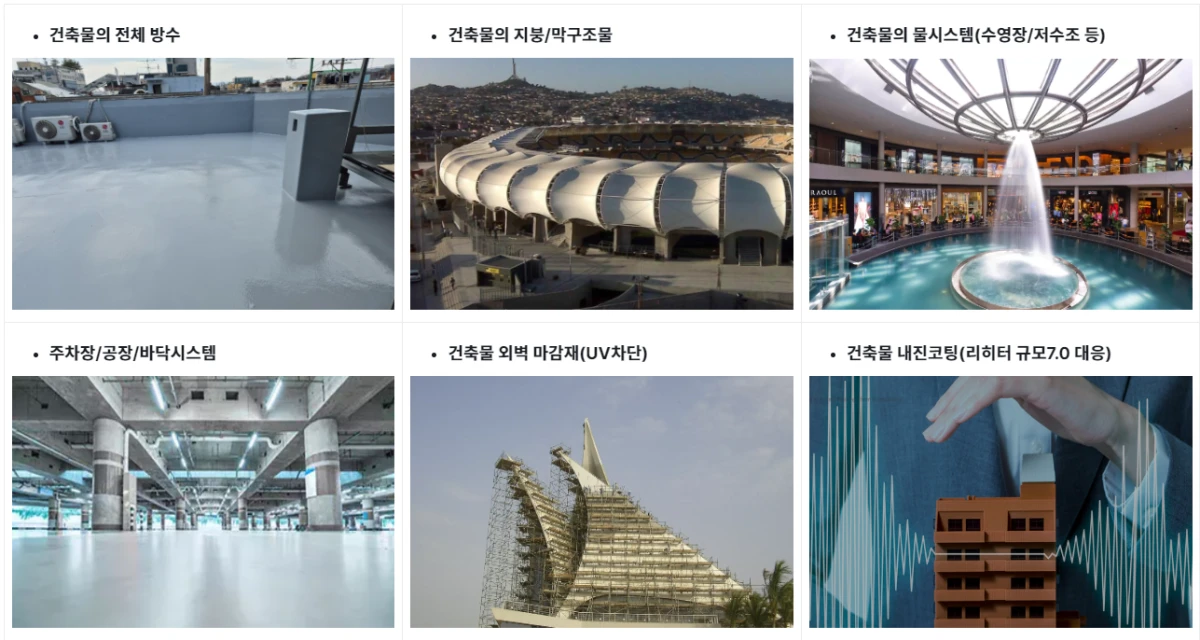
It is applied in 6 areas, from rooftop waterproofing to parking lot floors, exterior wall finishes, and seismic coatings.
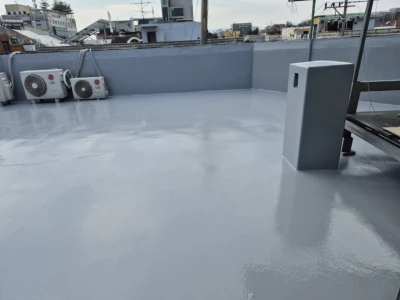
- Full Building Waterproofing
- Building Roofs/Membrane Structures
- Building Water Systems (e.g., swimming pools/reservoirs)
- Parking Lots/Factories/Floor Systems
- Building Exterior Wall Finishes (UV Protection)
- Building Seismic Coating (Richter Scale 7.0 Response)
What are the Key Performance Metrics?
Waterproofing lifespan, curing speed, tensile strength, and seismic performance are summarized numerically.
| Item | Value |
|---|---|
| Waterproofing Performance Lifespan | 3-5 times longer than traditional epoxy/urethane |
| Seismic Performance | Resistant to Richter scale 7.0 impacts |
| Curing Speed | Cures within 10 seconds, vehicle traffic possible within 30 minutes |
| Tensile Strength | Approximately 10 times that of general urethane |
| Volatile Organic Compounds (VOC) | Completely absent |
| Urethane Application Limitations (Comparison) | Workability decreases below 5 degrees Celsius in winter, reapplication required within 3-5 years of performance lifespan |
Other Business Areas
Site Consultation
The applicable method and cost vary depending on site conditions. Please leave your site information, and our representative will review it and contact you.
108 Munhwa-ro, Idong-eup, Cheoin-gu, Yongin-si, Gyeonggi-do
TEL 031-338-3689 · FAX 031-339-3689
Projects & Applications
Applied Products
Product selection varies based on site conditions and performance requirements. Start by reviewing the fundamental properties of polyurea and the distinctions between application methods.
Related Projects
View all case studies in this fieldFrequently Asked Questions
How does polyurea waterproofing differ from conventional urethane and epoxy?
Its waterproofing performance lifespan is 3 to 5 times longer than conventional epoxy and urethane, and its tensile strength is approximately 10 times that of general urethane. It cures within 10 seconds, enabling vehicle traffic within 30 minutes of application, and also offers seismic resistance capable of withstanding Richter scale 7.0 impacts.
What are the differences between SIPP, CIPP, and PVC lining methods?
CIPP is a cured-in-place method for large pipes, SIPP is a spray-in-place method for small pipes, and PVC lining involves adhering an internal sheet. While most companies specialize in only one rehabilitation method, HIGHCOATIC can handle all three, allowing us to select the optimal method tailored to specific site conditions.
What is polyurea?
It is an elastic coating material developed by Texaco in the early 1980s in the United States. It boasts an elongation of over 400%, concrete adhesion of over 3.0 N/mm², and heat resistance of 120°C for gases and 85°C for liquids. It is widely used for waterproofing, abrasion resistance, chemical resistance, and corrosion protection.
Do you hold environmental certifications?
All products have received eco-friendly certification for use in drinking water and food facilities. They contain 0% volatile organic compounds (VOCs) and have completed certification for use in drinking water and food facilities from relevant authorities in the US, Singapore, Canada, China, and other countries. Additionally, they hold ASTM E84 Class 1 flame spread certification.
What is HIGHCOATIC's relationship with NUKOTE?
HIGHCOATIC is the exclusive distributor of NUKOTE in South Korea. NUKOTE is an industrial protective coating manufacturer headquartered in Texas, USA, supplying over 140 countries worldwide and boasting a product lineup of over 80 types.
How can I request a quote?
Please leave your project details on the Quote Request page, and a representative will review them and contact you. For pipe rehabilitation, please provide the diameter, length, and current condition. For building waterproofing, please provide the area, number of floors, and whether existing waterproofing is present. This information will enable us to provide a more accurate quote. Phone consultations are available at 031-338-3689.
Other Business Areas
Building Flooring, Waterproofing, Seismic Resistance Need a Quote?
Let us know your site's scale and condition, and we will review applicable methods and products and get back to you. Phone consultations are available at 031-338-3689.