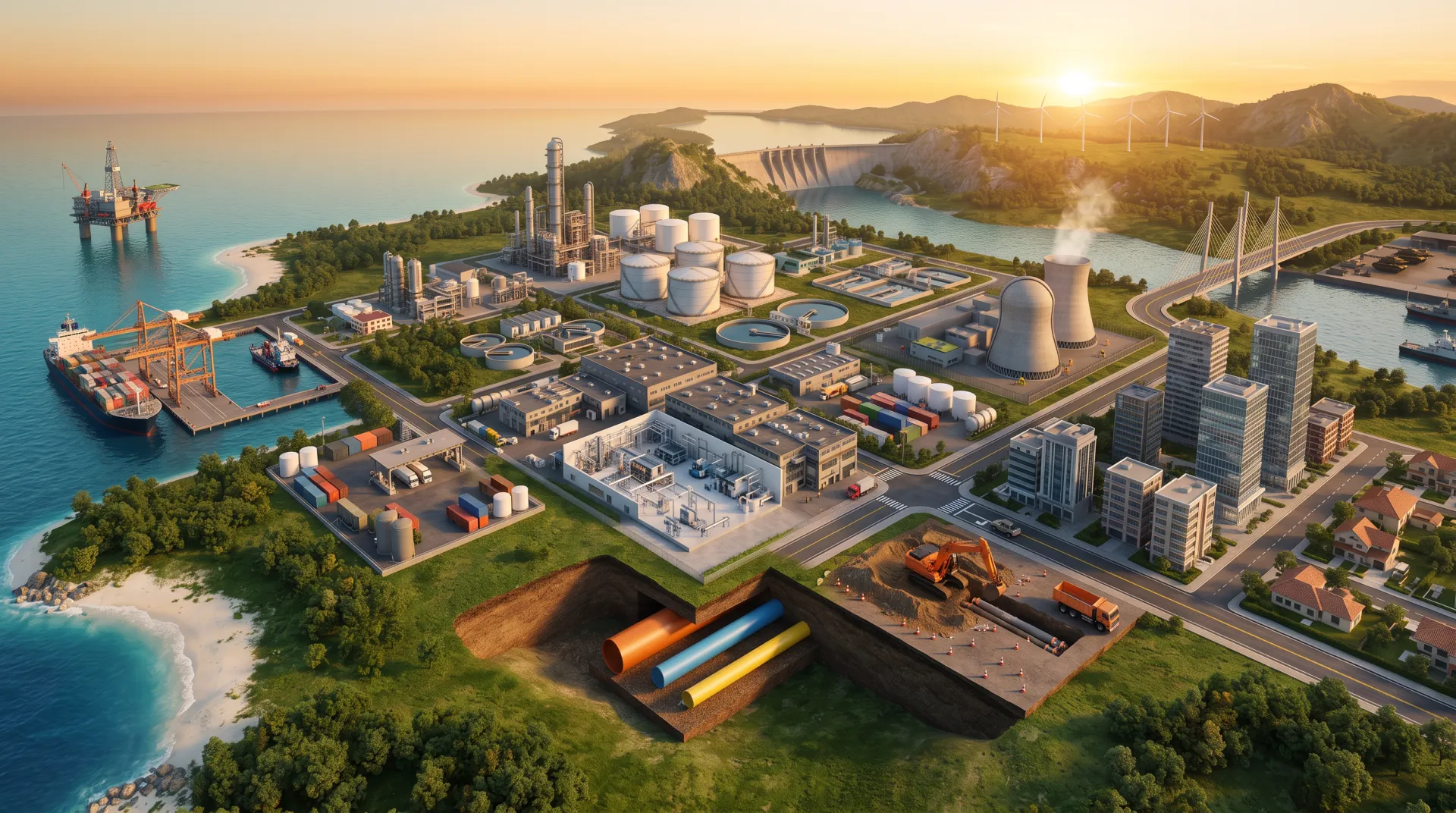
Overview map featuring industrial and infrastructure sites where HIGHCOATIC special coatings are applied.

Applied Fields

TOTAL SOLUTION · All Methods Covered

Specializing in SIPP, CIPP, and PVC
Total Trenchless Pipe Rehabilitation Solutions

Unlike competitors who specialize in a single construction method, HIGHCOATIC offers comprehensive SIPP, CIPP, and PVC lining solutions. This enables us to select the optimal method tailored to your site conditions, rather than forcing a specific method onto the site.

Two internally lined large-diameter steel pipes in a factory.

What is Trenchless Pipe Total Solution?

It refers to a single company providing solutions for various trenchless pipe rehabilitation methods (SIPP, CIPP, PVC lining), enabling them to select and apply the most suitable approach based on specific site conditions.

In the pipe rehabilitation market, most contractors only possess a single method. This means they are forced to apply their single method, regardless of the site conditions. HIGHCOATIC takes the opposite approach. We first assess the pipe diameter, curvature, surrounding environment, and the media being transported, then select the most suitable method for those specific conditions.

Furthermore, since we offer solutions based on the same polyurea material, extending beyond piping to include roof waterproofing and floor coating, you can manage an entire building or plant from a single source.

3
Applicable Lining Methods
SIPP, CIPP, PVC
19~51mm
Lining Thickness
(Typical coating 1~2mm)
4"~3m
Automated Lining Diameter
0%
Volatile Organic Compounds (VOC)
Eco-friendly materials
METHOD COMPARISON

What's the difference between SIPP, CIPP, and PVC lining?

CIPP is suitable for large diameter pipes, employing a method of inserting and curing a liner. SIPP is suitable for small diameter pipes, involving direct spraying onto the inner wall. PVC lining creates a protective layer by adhering a sheet to the interior.

Comparison of SIPP, CIPP, and PVC Lining Methods: Original Terms, Installation Principles, Suitable Pipe Diameters, and Application Fields
Category CIPP SIPP PVC
English original Cured-In-Place Pipe Spray-In-Place Pipe PVC Sheet Lining
Korean Text Cured-In-Place Pipe Lining Spray-Applied Pipe Lining PVC Sheet Lining
Working Principle After inserting a resin-impregnated liner (tube) into the pipe, it is cured internally, forming a new pipe within the existing one. Lining material is directly sprayed onto the inner wall of the pipe, forming a seamless protective and structural layer. HIGHCOATIC performs this application using the 360 Ringtech Robotics System, remotely controlled from the exterior. A PVC sheet is adhered to the interior of pipes and structures to form a protective layer.
Suitable Pipe Diameter Relatively large pipe Relatively small pipes Structure suitable for internal sheet adhesion
Main Application Sites Long, straight sections of large-diameter sewer and main pipelines Unmanned lining for diameters ranging from 4 inches (small bore) up to a maximum of 3 meters. For the interior of concrete pipes and water tanks requiring chemical-resistant protection
Points to review As this method involves pushing in the liner, application conditions for sections with numerous bends and branches are reviewed separately. The spray application method allows for installation regardless of pipe shape, and the absence of joints minimizes the risk of leakage. Pre-surface treatment is crucial as the condition of the sheet joints and existing surface determines performance.
HIGHCOATIC Support Supported Supported Supported

You can find more detailed construction procedures and material specifications for each method on the Method Comparison Page.

What's the Difference Between Lining and Coating?

Coating is the application of a thin layer to protect a surface, while lining involves reinforcing it with a thicker protective barrier.

Coating and Lining Comparison: Film Thickness, Purpose, and Results
Category Coating Lining
Coating Thickness Generally 1 to 2 mm 19 mm ~ 51 mm
Purpose Surface Waterproofing and Corrosion Prevention Waterproofing and corrosion prevention, in addition to structural reinforcement
Project Results Protective coating formation on existing pipe surfaces Effectively creates a new pipeline by forming a structural lining inside the existing pipe.
HIGHCOATIC Application Industrial Facility Corrosion Prevention, Flooring & Waterproofing Systems Trenchless Pipe Rehabilitation and Restoration (Patent Pending)
WHY TOTAL

Why Comprehensive Method Solutions are Crucial

The optimal method varies for each site. If only one method is available, the site must be adapted to that method. However, by offering a comprehensive range of methods, we can tailor the method to the specific site.

Single Method Contractor

  • For projects where their available methods are unsuitable, they either work around the conditions or abandon the project.
  • Projects combining piping, waterproofing, and flooring typically require separate contractors.
  • When multiple companies are involved, assigning responsibility for defects becomes challenging.

HIGHCOATIC Total Solution

  • We first assess pipe diameter, bends, and fluid conditions, then select the appropriate method.
  • We provide services ranging from pipe rehabilitation to roof waterproofing and floor coating, all from a single source.
  • A single entity is responsible for the entire process, from method selection to construction and after-sales management.

Three Variables That Change the Method Based on Field Conditions

VARIABLE 01

Pipe Diameter and Shape

Different methods are advantageous for large and small pipes. For pipes with numerous bends and branches, a spray application method, which can be applied regardless of the pipe's shape, is more advantageous than liner insertion.

VARIABLE 02

Fluid Type and Environment

The required chemical resistance performance and certification requirements vary depending on whether the application involves potable water, high-concentration chemicals, or seawater, brine, or wastewater.

VARIABLE 03

Water Shut-off & Operational Control Hours

The trenchless method eliminates the need for excavation, removing the necessity for surrounding area control. Its high-pressure spray and ultra-fast curing system enable rapid application and immediate use.

SCOPE

From underground piping to roofs and floors

HIGHCOATIC's scope of application extends to buried pipelines, pipelines running through building walls and facilities, roof waterproofing, and floor coatings.

LAYER 01

Underground Piping

We provide trenchless rehabilitation for buried pipelines, such as water and sewage systems. This approach eliminates the need for surrounding traffic control during installation, preventing the excavation and disruption of roads and sites.

View Trenchless Pipe Rehabilitation →
LAYER 02

Facilities, Piping, and Tanks

Protects the interior and exterior of facility pipelines and storage tanks that handle high-concentration chemical substances in industries such as semiconductor and petrochemicals, from corrosion.

View Water Treatment & Industrial Facilities →
LAYER 03

Roofing & Exterior Waterproofing

We apply polyurea to waterproof surfaces of buildings, including roofs, rooftops, and exterior walls. It is an eco-friendly material with 0% volatile substances.

View Building Waterproofing →
LAYER 04

Local Damage Repair

We provide precise, targeted repairs for localized damage, including cracks, joint leaks, and partial corrosion, specifically addressing cases where full rehabilitation is excessive.

View Pipe Maintenance →
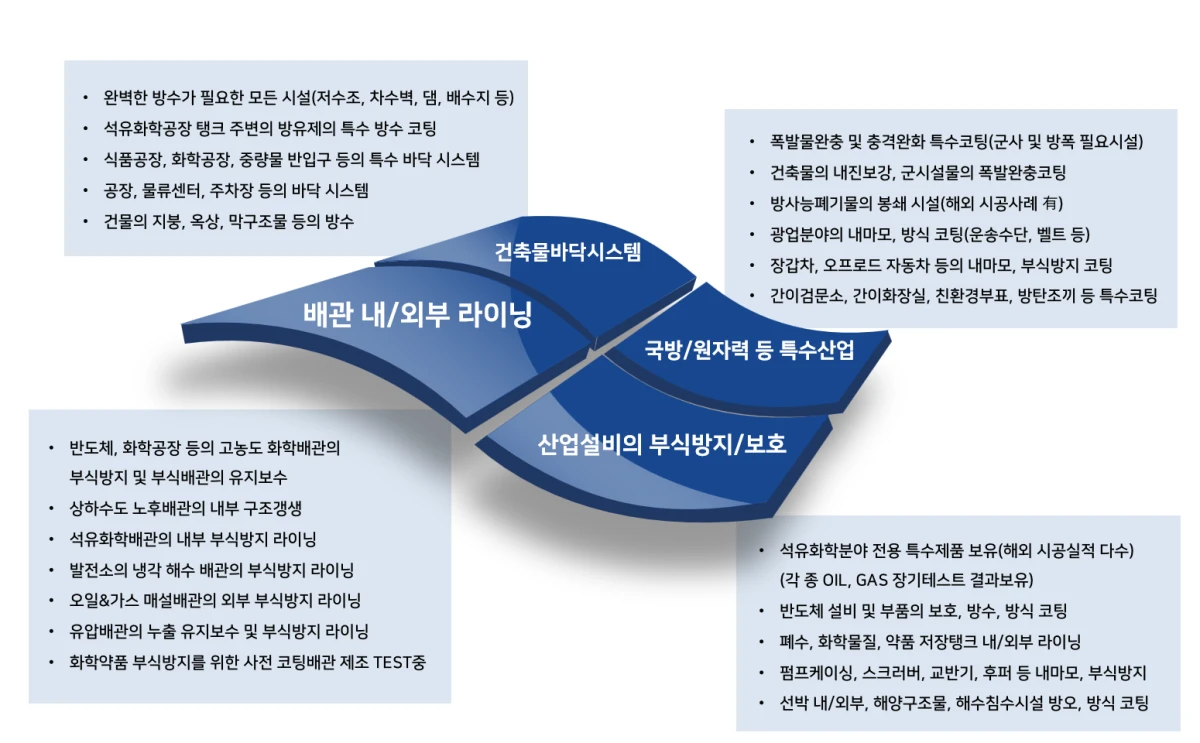
A diagram summarizing our four business areas—internal and external pipe lining, building floor systems, specialized industries (defense & nuclear), and industrial facility corrosion protection—and their respective application targets.
Our application scope, centered on internal and external pipe lining, extends to building floor systems, industrial equipment corrosion protection, and specialized industries such as defense and nuclear power.

Sites with Total Solutions Applied

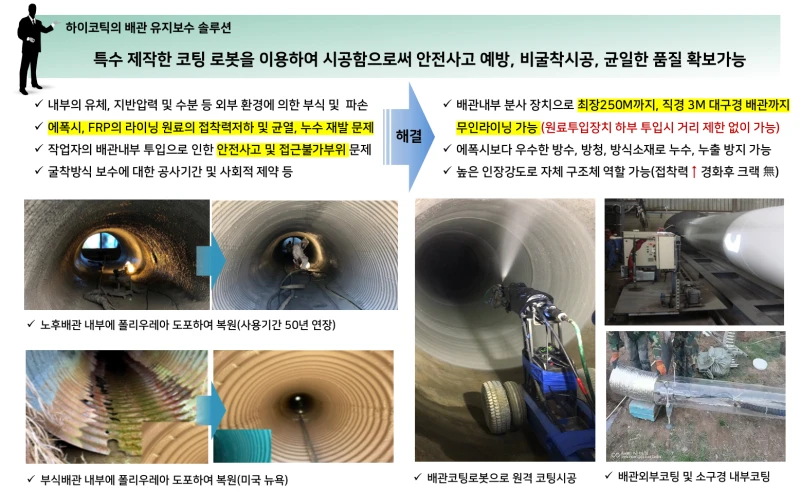
Comparison of challenges and solutions for HIGHCOATIC's pipe rehabilitation solution using coating robots.

Remote Robotic Application

Our specially designed coating robot is remotely operated from outside, eliminating the need for workers to enter the pipeline while ensuring consistent quality.

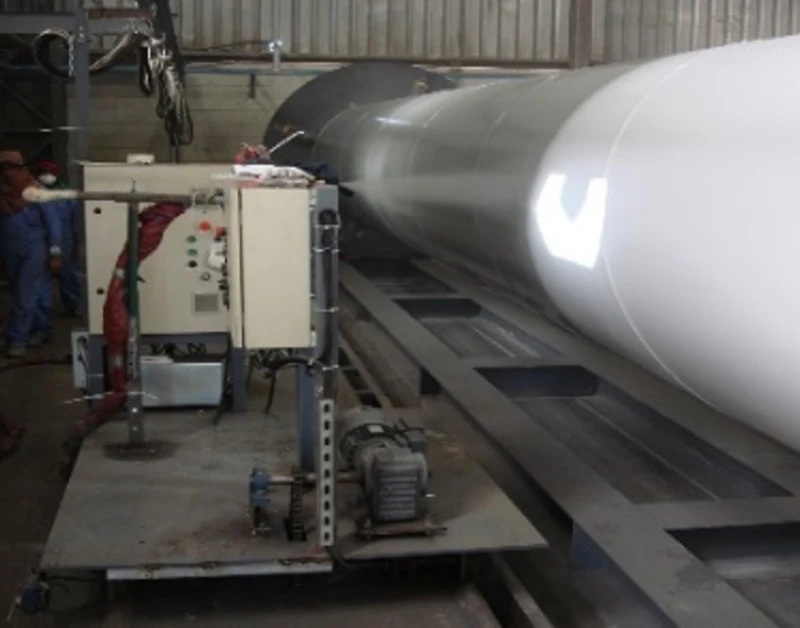
Automated application equipment for spraying lining material onto the exterior of large-diameter pipes in the factory.

Pipe Exterior Lining

We provide lining for both the interior and exterior of pipes. The absence of joints minimizes the risk of leaks.

Interior view of a large logistics warehouse with floor coating.

Floor and Waterproofing System

We apply polyurea to parking lot, factory, and logistics warehouse floors, as well as to building water systems such as swimming pools and water tanks.

FAQ

Frequently Asked Questions about Total Solutions

How do SIPP, CIPP, and PVC lining differ?

CIPP involves inserting a resin-impregnated liner into the pipe and curing it, making it suitable for relatively large pipes. SIPP involves directly spraying material onto the inner wall of the pipe, making it suitable for relatively small pipes. PVC lining creates a protective layer by adhering a PVC sheet to the interior. HIGHCOATIC supports all three methods.

Why is it important to offer a comprehensive range of rehabilitation methods?

The optimal rehabilitation method varies depending on pipe diameter, curvature, environmental conditions, and the type of fluid being transported. While a contractor with only one method is forced to adapt the site to their available technique, a company offering a comprehensive range of methods can match the optimal solution to the specific site conditions.

What is the difference between lining and coating?

Coating involves thinly covering a surface to provide waterproofing and corrosion prevention. Lining, conversely, is the concept of reinforcing with a thicker protective layer. HIGHCOATIC's pipe lining is not a typical 1-2 mm coating; rather, it is applied with a thickness of 19 mm to 51 mm, forming a structural component inside the pipe.

What pipe diameters can be rehabilitated?

We can robotically line pipes ranging from a small 4-inch diameter up to a maximum of 3 meters. The 360 Ringtech Robotics System allows for remote-controlled installation from the outside, eliminating the need for personnel to enter the pipe directly.

Does the trenchless method eliminate the need for road excavation?

Yes. Trenchless rehabilitation eliminates the need for excavation for pipe replacement, thereby minimizing disruption to the surrounding area during installation. This method offers superior social, economic, and time efficiency compared to conventional replacement approaches.

How far does the Total Solution extend beyond piping?

We apply our solutions to underground pipes, building walls, and facility pipes, as well as roof and exterior waterproofing and floor coatings. We can provide comprehensive solutions, from pipe rehabilitation to building systems, all from a single source.

For more questions, please visit our Customer Support FAQ.

Share your site conditions, and we'll define the optimal method together.

We can provide a consultation with just the pipe diameter, length, fluid type, and available downtime. 031-338-3689Please call us at :tel or request a quote.