Trenchless Pipe Rehabilitation Solutions (SIPP·CIPP)
Trenchless SIPP·CIPP Lining for Pipeline Rehabilitation
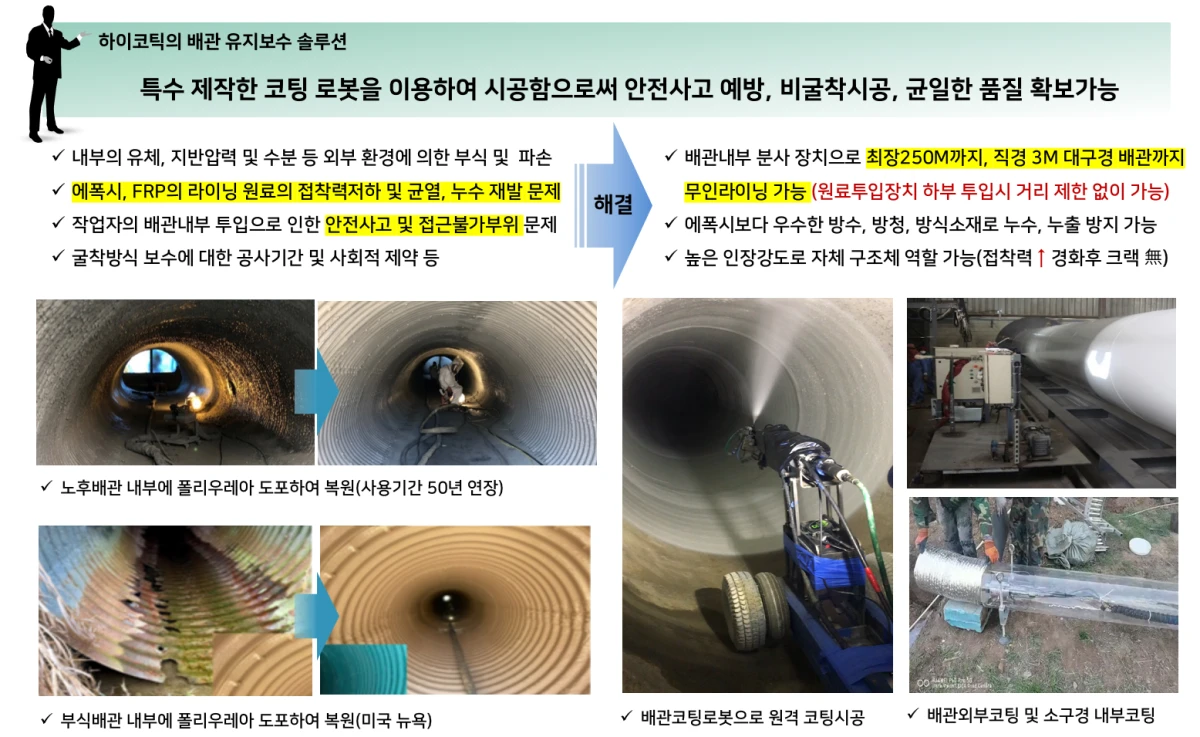
Restores the performance of old pipes by forming a seamless lining inside them using trenchless robotic technology. Unmanned installation is possible for pipe diameters from 30 to 3000mm and lengths up to 150m.
Why Rehabilitate Aging Pipes Instead of Replacing Them?
Replacing pipes requires excavation, but rehabilitation preserves existing pipes without excavation.
Since excavation is not required for pipe replacement (trenchless method), there is no need for surrounding area control during construction, and it is highly efficient socially, economically, and time-wise compared to traditional replacement methods. Road closures are avoided, and the construction period and costs for backfilling and pavement restoration are eliminated.
What is Trenchless Pipe Rehabilitation?
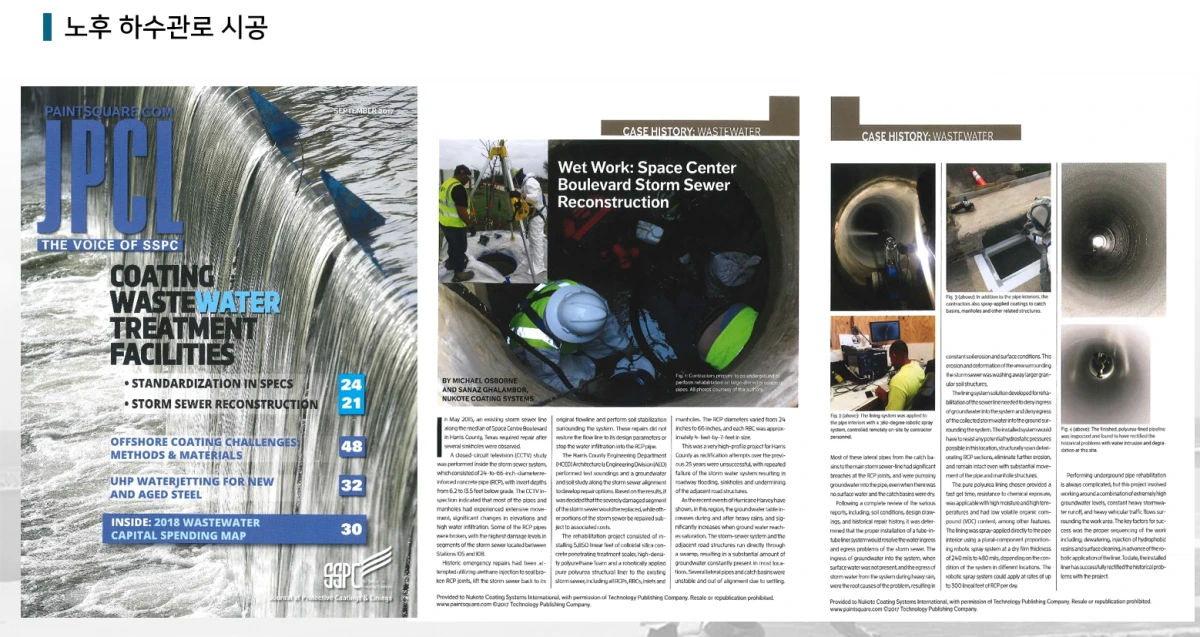
It is a method that forms a special polyurea lining inside the pipe, creating the effect of a new pipe.
Despite polyurea being a high-performance advanced material with excellent waterproofing, hardness, tensile strength, and corrosion resistance, in Korea, it is primarily used as a flooring material and waterproofing agent for buildings. However, in the U.S. and Europe, it is already widely used for industrial special coatings, particularly for internal and external lining applications aimed at protecting, strengthening, and restoring aging and corroded pipes in water and sewage facilities.
HIGHCOATIC utilizes special raw materials for pipe lining, not general-purpose polyurea used for flooring, providing not only corrosion-preventive coating for new pipes but also pipe restoration technology that utilizes existing aging pipes.
Why is a lining thickness of 19-51mm important?
Unlike thin coatings of 1-2mm, it creates a structural body inside the pipe, effectively creating a new pipe.
The most significant feature of HIGHCOATIC's lining technology is that it allows for lining thicknesses of 19mm to 51mm, unlike typical thin coatings of 1-2mm. This goes beyond simple waterproofing and corrosion prevention, as it forms a structural body inside the pipe, effectively creating a new pipe.
How is installation performed without human entry into the pipe?
Specially designed robots are remotely controlled from outside the pipe to perform unmanned internal lining.
HIGHCOATIC's pipe lining is installed without direct human entry, as it is remotely controlled by specially designed robots from outside, ensuring worker safety and achieving more uniform performance.
11 Features of HIGHCOATIC Pipe Lining
From installation methods to certifications, we have categorized the performance features that differentiate it from general coatings.
| Category | Description |
|---|---|
| Installation Method | Application of 360 Ringtech Robotics System, remotely controllable from outside without excavation |
| Installable Diameter | Unmanned lining possible for pipes from a small diameter of 4 inches up to a maximum diameter of 3 meters |
| Curing Speed | High-pressure spray, ultra-fast curing (cures within seconds) system enables rapid installation and use |
| Application Method | Various application methods such as spray, roller, and brush allow installation regardless of pipe shape |
| Hardness & Abrasion Resistance | High hardness of Shore D 80 and excellent abrasion resistance prevent wear and corrosion caused by internal foreign matter |
| Earthquake & Explosion Resistance | Material with earthquake and explosion resistance, excellent tensile strength reduces cracking in concrete pipes |
| Chemical Resistance | Strong chemical resistance to high-concentration chemicals, seawater, salt, and wastewater prevents pipe corrosion |
| Leakage Risk | Absence of pipe joints reduces the risk of leakage |
| Worker Safety | 0% volatile organic compounds (VOCs), eco-friendly material ensures worker safety |
| Drinking Water & Food Contact Certification | All products are certified for use in drinking water and food facilities by relevant authorities in the U.S., Singapore, Canada, China, etc. |
| Flame Spread Rating | Certified Class 1 Flame Spread Rating according to ASTM E84 |
What are the related patents?
Three patents related to pipe lining and one for flexible leak mold, totaling four applications.
- Polyurea Resin Composition for Lining for Corrosion Prevention and Rehabilitation of Aging Pipes
- Polymer Spray Lining Method for Trenchless Pipeline Rehabilitation
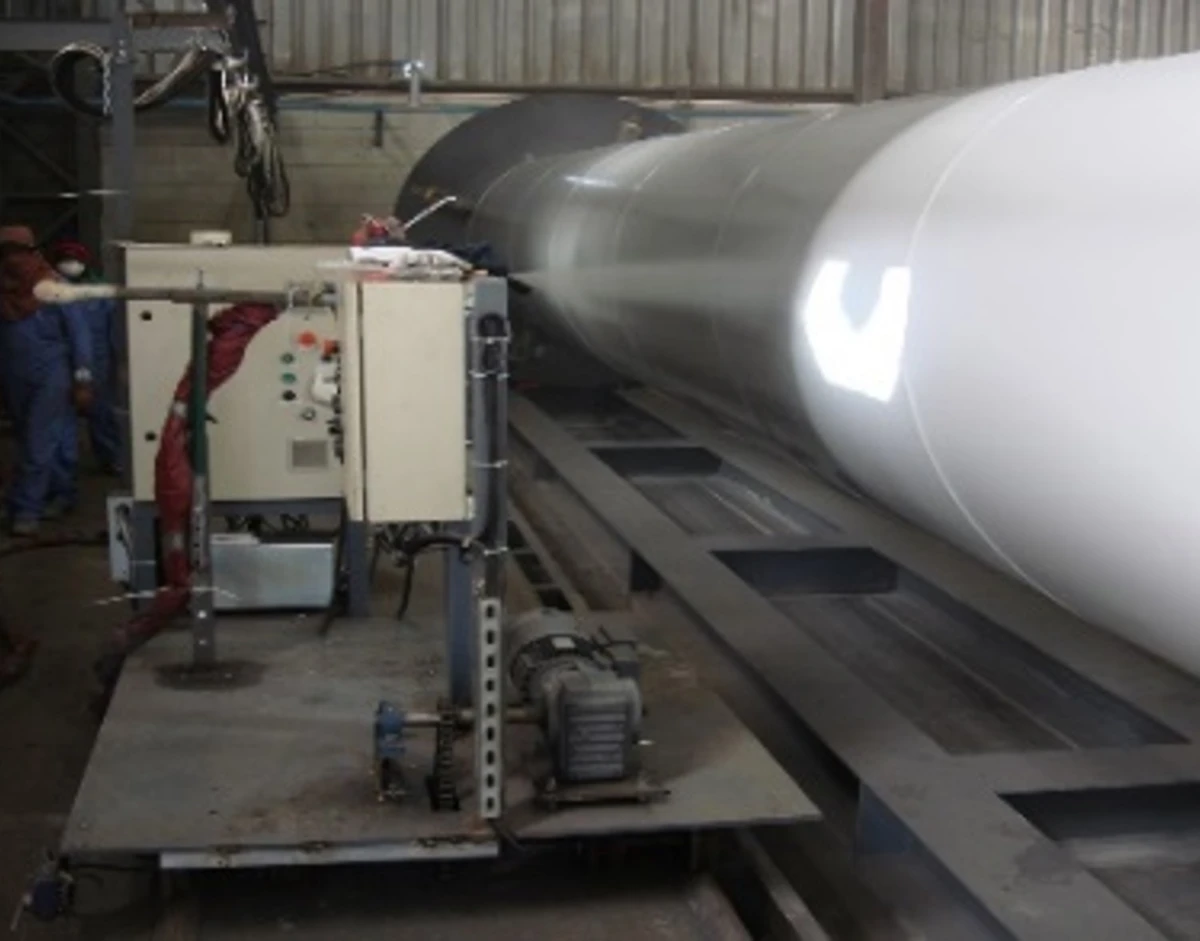
- High-Pressure Automatic Spraying Device for Polyurea Lining Inside Pipes
- Pipe Maintenance Technology — Flexible Leak Mold
What is Flexible Leak Mold technology?
It is a patented technology that seals leakage points with molding, without pipe replacement or welding.
HIGHCOATIC's patented Flexible Leak Mold technology concerns a method for sealing leaks in pipes requiring high corrosion and acid resistance, such as those in semiconductor, pharmaceutical, and petrochemical industries, without pipe replacement or welding. It involves creating a mold using a flexible sheet, fastening it to the leaking pipe section, and then injecting and curing a special corrosion and acid-resistant polyurea into the mold to repair the leak. This technology is applicable even in situations where replacement or conventional repair methods are impossible due to the diverse shapes of pipes and extremely confined spaces characteristic of semiconductor facilities.
What are some international installation cases?
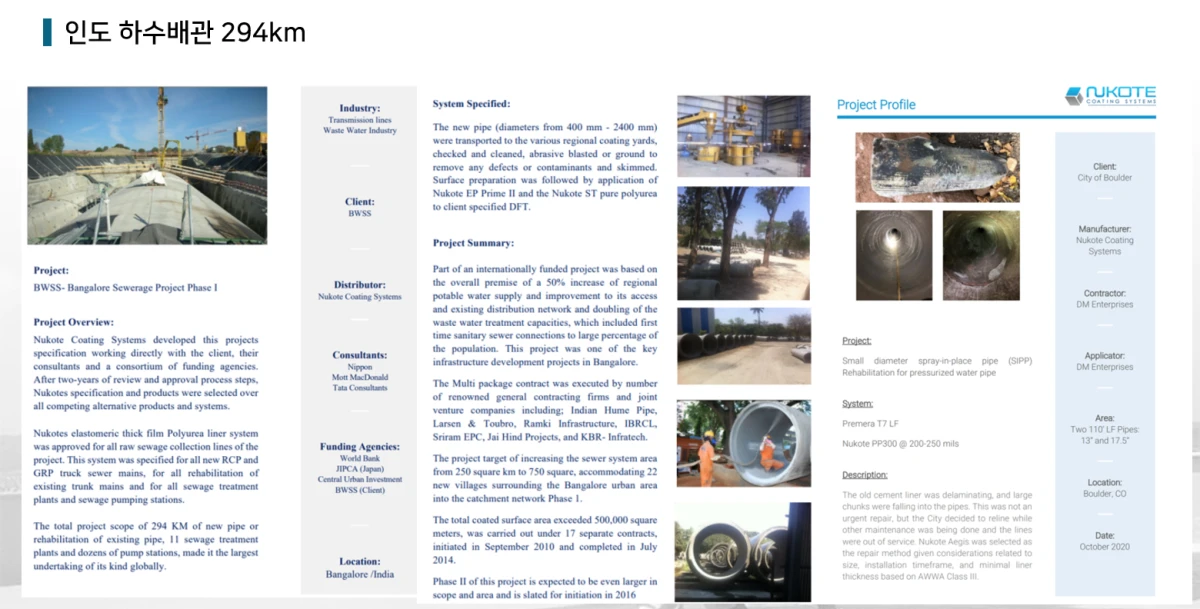
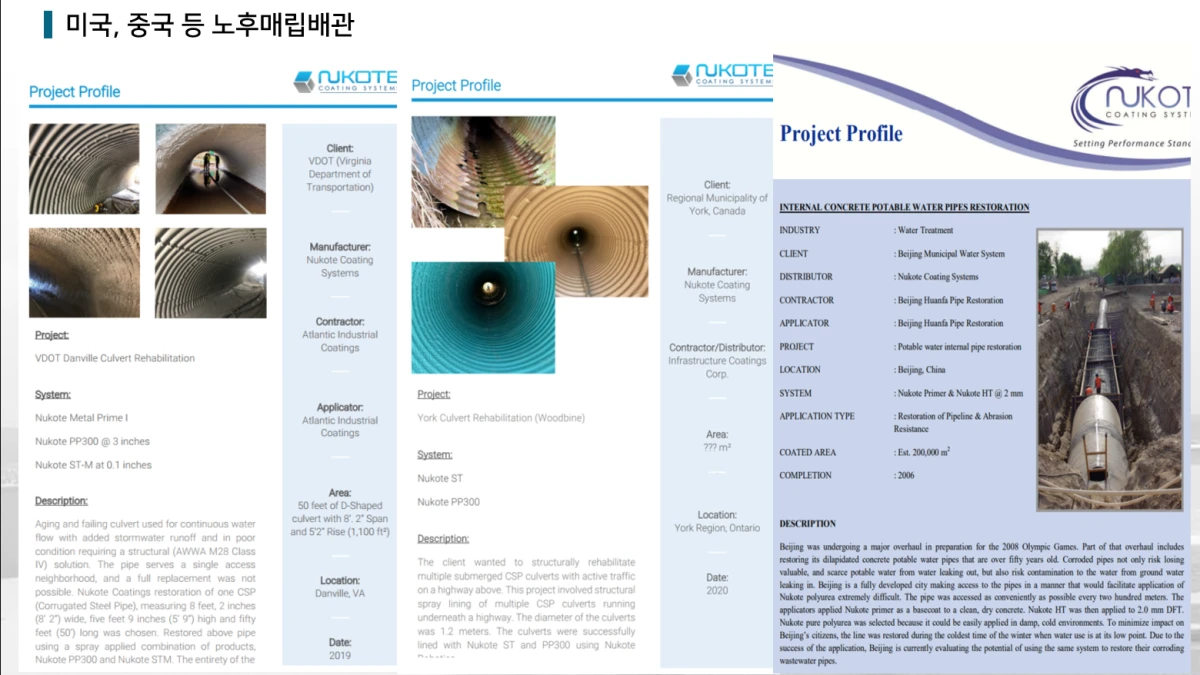
Large-diameter pipeline rehabilitation has been performed in Canada, the U.S., Australia, and Saudi Arabia.
| Country | Client | Diameter | Length | Year |
|---|---|---|---|---|
| Canada | City of Vancouver | 1.8m | 1km | 2022 |
| Canada | City of Edmonton | 1.2m | 1.7km | 2022 |
| Canada | City of Toronto | 1.2m | 3.5km | 2020 |
| Canada | City of Barrie | 2m | 500m | 2023 |
| U.S. | Harrison County, Texas | 0.5m~1.6m | 4m underground vertical pipe | 2017 |
| Louisiana | Baton Rouge | 1.8m | 700m | 2022 |
| U.S. | Los Angeles | 2.8m | 1.1km | 2020 |
| U.S. | Colorado | 1m | 2.4km | 2018 |
| Australia | Trility Pumping Station | 1.8m | 10km | 2023 |
| Saudi Arabia | Saudi Ministry of Water | 1.5m | 210km | 2028 |
| Saudi Arabia | Saudi Ministry of Irrigation | 1.2m | 50km | 2025 |
In addition, we are undertaking hundreds of large-scale projects worldwide.
Other Business Areas
Site Consultation
The applicable method and cost vary depending on site conditions. Please leave your site information, and our representative will review it and contact you.
108 Munhwa-ro, Idong-eup, Cheoin-gu, Yongin-si, Gyeonggi-do
TEL 031-338-3689 · FAX 031-339-3689
Projects & Applications
Applied Products
Product selection varies based on site conditions and performance requirements. Start by reviewing the fundamental properties of polyurea and the distinctions between application methods.
Related Projects
View all case studies in this fieldFrequently Asked Questions
What is trenchless pipe rehabilitation?
This is a method for rehabilitating deteriorated pipes by forming a lining inside them without excavation. While pipe replacement necessitates excavation, the trenchless method utilizes the existing pipes, eliminating the need for site control during construction, and proving significantly more efficient in social, economic, and temporal aspects.
What is the maximum pipe diameter that can be rehabilitated?
Pipes ranging from 4 inches in diameter up to 3 meters can be lined autonomously. Since the 360 Ringtech Robotics System allows for remote control from outside, personnel do not need to enter the pipe, ensuring worker safety and more uniform performance.
What is the lining thickness?
19mm to 51mm. Unlike typical coatings that are 1-2mm thick, this thickness forms a structural layer inside the pipe, effectively creating a new pipe rather than merely providing waterproofing or corrosion protection.
What are the differences between SIPP, CIPP, and PVC lining methods?
CIPP is a cured-in-place method for large pipes, SIPP is a spray-in-place method for small pipes, and PVC lining involves adhering an internal sheet. While most companies specialize in only one rehabilitation method, HIGHCOATIC can handle all three, allowing us to select the optimal method tailored to specific site conditions.
What is polyurea?
It is an elastic coating material developed by Texaco in the early 1980s in the United States. It boasts an elongation of over 400%, concrete adhesion of over 3.0 N/mm², and heat resistance of 120°C for gases and 85°C for liquids. It is widely used for waterproofing, abrasion resistance, chemical resistance, and corrosion protection.
Do you hold environmental certifications?
All products have received eco-friendly certification for use in drinking water and food facilities. They contain 0% volatile organic compounds (VOCs) and have completed certification for use in drinking water and food facilities from relevant authorities in the US, Singapore, Canada, China, and other countries. Additionally, they hold ASTM E84 Class 1 flame spread certification.
What is HIGHCOATIC's relationship with NUKOTE?
HIGHCOATIC is the exclusive distributor of NUKOTE in South Korea. NUKOTE is an industrial protective coating manufacturer headquartered in Texas, USA, supplying over 140 countries worldwide and boasting a product lineup of over 80 types.
How can I request a quote?
Please leave your project details on the Quote Request page, and a representative will review them and contact you. For pipe rehabilitation, please provide the diameter, length, and current condition. For building waterproofing, please provide the area, number of floors, and whether existing waterproofing is present. This information will enable us to provide a more accurate quote. Phone consultations are available at 031-338-3689.
Other Business Areas
Trenchless Pipe Rehabilitation Solutions Need a Quote?
Let us know your site's scale and condition, and we will review applicable methods and products and get back to you. Phone consultations are available at 031-338-3689.