POLYUREA

What is Polyurea, and Why is it Strong?

Polyurea is a cutting-edge material developed by Texaco in the early 1980s. With strength comparable to concrete and an elongation rate exceeding 400%, its applications extend beyond flooring to include pipelines, plants, and military facilities.

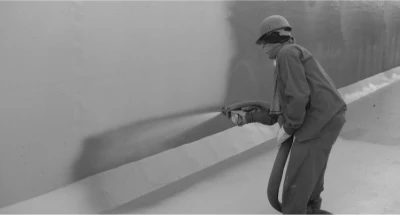
Worker spraying polyurea onto a wall with a spray gun
DEFINITION

What is Polyurea?

A coating material created by the reaction of isocyanate and amine (a curing agent), forming a waterproof film layer.

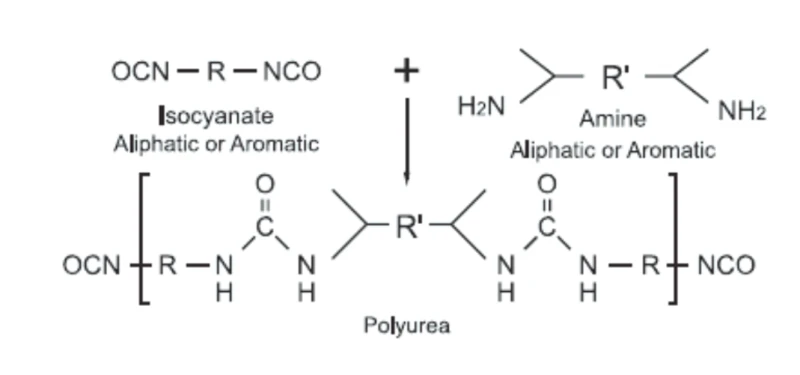
Polyurea is a cutting-edge material developed by Texaco in the USA in the early 1980s, formed by the reaction of isocyanate and amine as a curing agent. When heated, mixed, and sprayed, it creates chemically stable bonds and forms a waterproof coating layer, making it an excellent product for the repair, reinforcement, protection, waterproofing, and corrosion protection of floors or structures such as concrete.

Chemical reaction diagram showing isocyanate and amine reacting to form polyurea.
STRENGTHS

Three Strengths of Polyurea

Overwhelming Strength

The most remarkable strengths of polyurea are its strength and flexibility. It offers concrete-level strength, yet depending on the grade, boasts an elongation rate exceeding 400%. The strength derived from this flexibility is even utilized as an explosion-proof measure in military facilities, and particularly for cracks in concrete substrates, it conforms without cracking, providing absolute protection for the substrate.

Overwhelming Ease of Handling

Polyurea is primarily applied by spray coating, enabling the coverage of approximately several hundred square meters in a single day. Moreover, its exceptional rapid-curing properties mean it cures within seconds to minutes after spraying, allowing for foot traffic within a few hours. This ease of application and outstanding handling convenience significantly broaden its range of uses.

Chemical Resistance · Abrasion Resistance · Weather Resistance

Polyurea also offers outstanding chemical and corrosion resistance. Depending on the grade, it exhibits long-term resistance to 50% sulfuric acid, protecting the substrate from corrosion caused by acids and alkalis. Furthermore, in the JIS standard paint abrasion test, with a film loss of just 3mg after testing, it demonstrates unrivaled abrasion resistance compared to other lining materials, and its superior weatherability ensures long-term protection of the substrate even in harsh outdoor environments.

Over 400%
Elongation (400-450% depending on grade)
3.0 N/mm²
Concrete Adhesion (min.)
120℃ / 85℃
Heat Resistance (Gas / Liquid)
30.7
Oxygen Index (FR Grade, JIS K 7201-2:2007)
APPLICATION

Where is polyurea used?

Application targets vary depending on the required performance. Below are the key applications based on product characteristics.

Main Applications by Polyurea Product Characteristics
Product Features Key Applications
Chemical Resistance, Corrosion Resistance
  • Chemical piping, chemical tanks, wastewater tanks
  • Seawater immersion facilities, various chemical plant equipment
  • Chemical facility flooring
  • Mixing Equipment and Parts
Weather Resistance (UV Protection, Fade Resistance)
  • Building roofs and exterior walls
  • Protection of outdoor facilities
  • Topcoat over existing coatings
  • No change in properties or performance with temperature variations.
Abrasion Resistance, High Strength
  • Flooring for factories, airports, and military facilities
  • Dam, livestock, and mining equipment
  • Infrastructure such as roads and bridges
  • Mixing Equipment and Military Equipment
Waterproof, Moisture Barrier
  • Waste Containment Facilities
  • Waterproofing concrete waterways and structures
  • Membrane Structure Waterproofing
  • Swimming pools, water parks, etc.
Thermal Insulation, Heat Reflection, Cryogenic, High-Temperature Resistance
  • Protection for High-Temperature Equipment and Facilities
  • Cold/Freezer Storage
  • Building Thermal Insulation/Heat Reflection for Energy Savings
  • Thermal insulation coating for various products
Blast-resistant functionality (high elongation and tensile strength)
  • External coating for explosion-hazard facilities and products
  • Bridges, railways requiring vibration and impact mitigation
  • Facilities requiring protection from impacts such as earthquakes
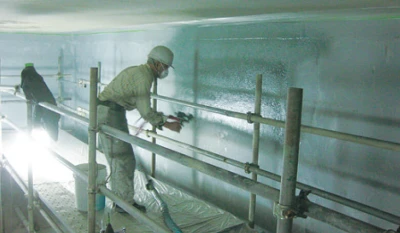
On-site waterproofing and anti-corrosion application of spray-applied polyurea to water tank interior walls.
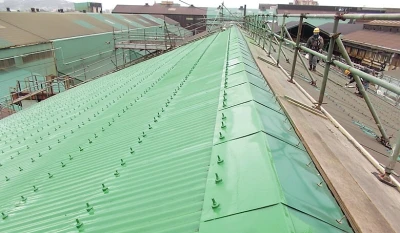
Application of green polyurea weather-resistant coating on the exterior walls and roof of a factory.
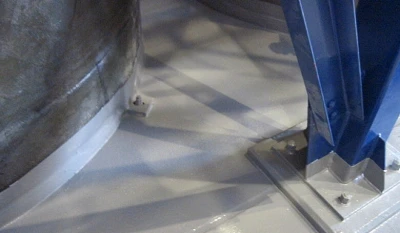
Polyurea chemical-resistant coating completed on the lower floor of plant facilities.
TEST DATA SHEET

Polyurea Performance Test Data

This is an analysis of wear resistance, chemical resistance, and flame retardancy ASTM standards by product.

Taber Abrasion Test Results (CS-17 / CS-10)

Load 9.81 N (1 kgf) / 1,000 test cycles · Test standard ASTM D4060 (abrasion wheel CS-17), Test specification JIS K 5600-5-9 : 1999 (abrasion wheel CS-10)

Taber Abrasion Test Results — Abrasion Loss (mg) by Product Grade
Test Standard ST XT AL LP PA BG
ASTM D4060 / CS-17 8 20 35 30 25 -
JIS K 5600-5-9 : 1999 / CS-10 3 14 - - - 3

Abrasion Loss (mg)

2. Chemical Resistance Performance Test Data

Complies with ASTM D3912 (Weight Change) · ● = Recommended / ○ = Conditionally recommended

Chemical resistance performance test results by grade for 29 types of chemicals
Chemical Name Concentration ST XT LP PA
Hydrochloric Acid 10%
Hydrochloric Acid 15% × × ×
Sulfuric Acid 15%
Sulfuric Acid 50% × × ×
Phosphoric Acid 10%
Phosphoric Acid 15% × × ×
Acetic acid 10%
Nitric Acid 25% × × ×
Hydrogen Fluoride 10% × × ×
Seawater
Sewage
Water (80°C)
Deionized Water - -
Diesel, Gasoline
Hydraulic Oil
Perchloric Acid - - -
Citric Acid 5% - - -
Detergent - - -
Sodium Hydroxide (Caustic Soda) 20%
Sodium Hydroxide (Caustic Soda) 50% -
Ammonium Hydroxide 20%
Ammonium Hydroxide 50%
Potassium Hydroxide 10%
Potassium Hydroxide 20%
Soda ash 30% - - -
Hypochlorous acid 14% - - -
Calcium Hydroxide 30% - - -
Hydrogen sulfide gas
Hydrogen Peroxide - - -

Note: We recommend a preliminary immersion test to verify chemical resistance performance, taking into account its correlation with temperature. For further details, please consult our representative.

3. Flame Retardancy Test Results by Oxygen Index

Test Standard: JIS K 7201-2 2007 Flame Retardancy Criteria: - 22 or less: Flammable material - 23 to 27: Self-extinguishing material - 27 or more: Flame-retardant material

Flame Retardancy Test Results by Oxygen Index
Grade Oxygen Index
FR 30.7
COMPARISON

What is the difference between polyurea and other materials?

HIGHCOATIC's flagship polyurea product is compared item-by-item with polyurethane, epoxy, FRP, and polymer cement systems.

Detailed Comparison of Polyurea, Polyurethane, Epoxy, FRP, and Polymer Cement Systems
Category Polyurea Polyurea Epoxy FRP Polymer Cement-based
Abrasion Resistance 8 mg abrasion loss (CS17 wheel, 1 kg load, 1000 revolutions) 293mg abrasion loss (CS17, 1kg, 1000 rotations) 55 mg abrasion loss (CS17, 1 kg load, 1,000 cycles) 108mg Abrasion Loss (CS17, 1kg, 1000 Revolutions) No data available
Chemical Resistance 15% Sulfuric Acid Resistance / 50% Sulfuric Acid Resistance 20% Sulfuric Acid Resistance (at room temperature) 20% Sulfuric Acid Resistance (Room Temperature) Resistant to 80% sulfuric acid (at room temperature) Resistant to 80% sulfuric acid (at room temperature)
Heat Resistance Gas 120℃ / Liquid 85℃ 110℃ Around 80℃ 70℃~100℃ Gas: 120°C, Liquid: 90°C
Corrosion JS D1 Compliant Not suitable for JS JS D1 Compliant JS D1 Compliant No data available
Waterproof Zero Permeability Zero Permeability Zero Permeability Zero Permeability Water Permeability Passed / Vapor Permeable
Concrete Adhesion 3.0 N/mm² or more 2.5 N/mm² or more 2.5 N/mm² or more 1.5 N/mm² or more 1.5 N/mm² or more
Crack Bridging Elongation 400%~450% Elongation 50±5% Less than 5% elongation Less than 5% elongation Along 0.5mm cracks
Workability Rapid-curing spray application allows for smooth installation even on uneven surfaces or in confined spaces. Rapid-curing spray application allows for smooth installation even on uneven surfaces or in confined spaces. When applied manually, a fiber sheet is added for laminated application. Manual application requires multiple coats, and FRP mats are susceptible to lifting/delamination during installation. Good workability.
Volatile Component None None Not included by default Volatile components in sheet jointing material None
Curing Cure Time Minutes Cure Time Minutes Cure time: Approximately 1 hour Curing time 48 hours 48-hour cure, ready for water service after 7 days
Film Characteristics Seamless with a continuous film Seamless with a continuous film Seamless with a continuous film Discontinuous Seamless with a continuous film
Repairability Partially Repairable Partially Repairable After partial removal, recoating is possible Partially Repairable Degree of Repair

Highcoatic Coating Systems' Elastomerics is a portfolio of flexible protective barrier coatings.

FAQ

Polyurea FAQ

What is polyurea?

Polyurea is a material developed by Texaco in the United States in the early 1980s. It is formed by the reaction of isocyanate and amine, a hardener. When heated, mixed, and sprayed, a chemically stable bond and a waterproof coating layer are formed, making it suitable for the repair, reinforcement, waterproofing, and corrosion protection of concrete floors or structures.

What is the percent elongation of polyurea?

While maintaining concrete-level strength, it achieves an elongation of over 400% depending on the grade, and 400-450% based on comparative test standards. This flexibility enables it to follow cracks in concrete substrates without fracturing.

What is the difference between polyurea and epoxy?

In the Taber Abrasion Test (CS-17, 1kg, 1000 cycles), polyurea exhibited 8mg of weight loss, while epoxy showed 55mg. For crack bridging ability, polyurea has an elongation of 400-450%, compared to less than 5% for epoxy. Their heat resistance is approximately 120℃ (gas) / 85℃ (liquid) for polyurea, and about 80℃ for epoxy.

How quickly does polyurea cure?

The primary application method is spray coating, allowing for approximately several hundred square meters of application per day. It cures within seconds to minutes after spraying and is walkable within a few hours.

Is polyurea non-flammable?

In the JIS K 7201-2(2007) Oxygen Index Test, the oxygen index for the FR grade is 30.7. According to this standard, materials with an oxygen index of 27 or higher are classified as flame-retardant.

How is the chemical resistance performance of polyurea verified?

We provide applicability for 29 types of chemicals across ST, XT, LP, and PA grades, based on a weight change test conforming to ASTM D3912. For actual applications, a preliminary immersion test that considers the correlation with temperature is recommended.

Consult us about applicable grades.

The recommended grade varies depending on the type of chemicals and temperature of the service environment. Please contact us for product-specific TDS and MSDS.