METHODS

SIPP & CIPP Differences, and Lining & Coating Distinctions

Although all methods are categorized as 'trenchless pipe rehabilitation,' their principles and applicable pipe diameters differ by technique. HIGHCOATIC does not specialize in a single rehabilitation method. Instead, we select the technique best suited to the specific site conditions.

Two large-diameter steel pipes with internal lining coating installed, lying in a factory.
BASICS

What is Trenchless Pipe Rehabilitation Method?

It is a trenchless method that rehabilitates deteriorated pipelines without replacement, by forming a new layer inside the existing pipe.

Despite being a high-performance advanced material offering superior waterproofing, hardness, tensile strength, and corrosion resistance, polyurea is primarily utilized in Korea for building floors and as a general waterproofing agent. However, in the United States and Europe, it has already become a standard for industrial special coatings, particularly for internal and external lining applications aimed at protecting, strengthening, and rehabilitating aged or corroded pipes within water and sewage infrastructure.

The trenchless method for pipe replacement eliminates the need for excavation, removing the requirement for surrounding traffic control during installation. This results in significant social, economic, and time efficiencies compared to traditional replacement methods.

SIPP vs CIPP

What is the difference between SIPP and CIPP?

SIPP is a method where material is sprayed inside the pipe and then solidified in place, while CIPP is a method where a liner is inserted and then cured in place.

Comparison of SIPP and CIPP Methods
Category SIPP CIPP
English Name Spray-In-Place Pipe Cured-In-Place Pipe
Principle Directly spraying lining material inside the pipe to form a coating in situ. A liner (pipe) is inserted into the pipeline and then cured in situ.
Main Applicable Pipe Diameter Small diameter pipes Large Diameter Pipes
HIGHCOATIC Application Method Polyurea High-Pressure Spray Lining (360 Ringtech Robotics Remote Application)

HIGHCOATIC aims to provide total solutions that encompass all rehabilitation methods, including SIPP, CIPP, and PVC lining. Rather than specializing in a single technique, we select the most suitable method based on the pipe's diameter, application, and specific site conditions.

COATING vs LINING

What is the difference between coating and lining?

They differ in thickness, and therefore, in function. Coating protects the surface, while lining rebuilds the pipe itself.

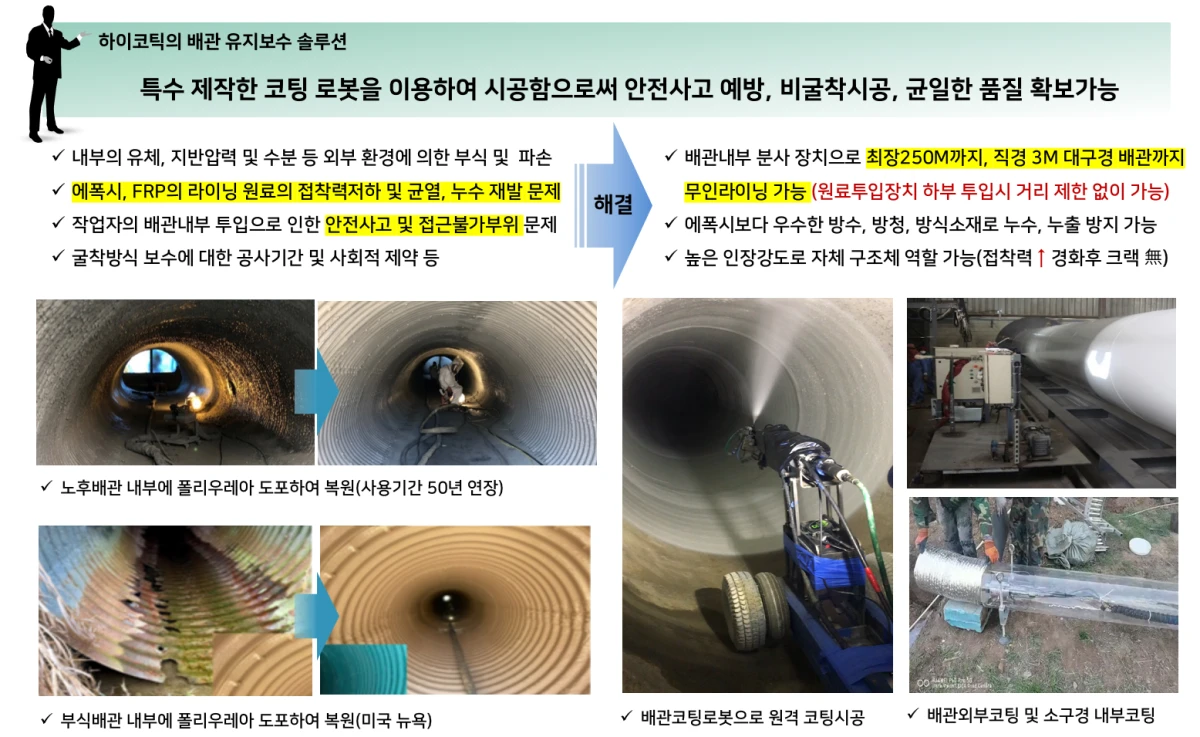
The most significant feature of HIGHCOATIC's lining technology is its ability to apply lining thicknesses of 19mm to 51mm, rather than typical thin coatings of 1-2mm. This goes beyond simple waterproofing and corrosion prevention, forming a structural body within the pipe, thereby effectively creating a new pipe. HIGHCOATIC's pipe lining is applied without human entry, as it is remotely controlled and installed from the outside using specially manufactured robots, ensuring worker safety and delivering more uniform performance.

HIGHCOATIC Pipe Lining vs. General Coating
Category General Coating HIGHCOATIC Pipe Lining
Thickness 1~2 mm 19~51 mm
Role Forms a waterproof and anti-corrosion coating Effectively creates a new pipe by forming a structural layer within the existing pipeline.
Installation Method Spray, Roller, Brush Application External remote-controlled application using a custom-engineered robot (unmanned)
Diagram illustrating the rehabilitation process of aging pipelines by remotely applying polyurea inside them using a specialized coating robot.
SPEC

HIGHCOATIC Spray Lining Application Specifications

19~51 mm
Lining Thickness
4″ ~ 3 m
Unmanned Rehabilitation Diameter
Shore D 80
Coating Hardness
0%
Volatile Organic Compounds (VOC)

HIGHCOATIC Pipe Lining Features

  • Application of the trenchless, externally remote-controlled 360 Ringtech Robotics System
  • Unmanned lining for pipes from 4 inches up to 3 meters in diameter.
  • High-pressure spray and ultra-fast curing system (cures in seconds) enables rapid application and immediate use.
  • Can be applied regardless of pipe shape, utilizing various methods including spray, roller, and brush.
  • High hardness (Shore D 80) and abrasion resistance prevent wear and corrosion caused by internal foreign substances.
  • Excellent tensile strength from a seismic and explosion-proof material reduces cracking in concrete pipes.
  • Excellent chemical resistance to high-concentration chemicals, seawater, salt, and wastewater, preventing pipe corrosion.
  • No pipe joints, reducing the risk of leakage.
  • Zero VOCs, ensuring worker safety with eco-friendly materials
  • All products are certified for use in drinking water and food facilities by relevant authorities in the US, Singapore, Canada, China, and other countries.
  • ASTM E84 Class 1 Flame Retardant Certification

Related Patent Application Notice

  • Polyurea Resin Composition for Lining Pipes to Prevent Corrosion and Rehabilitate Deteriorated Pipelines
  • Polymer Spray Lining Method for Trenchless Pipe Rehabilitation
  • High-Pressure Automatic Spray Device for Polyurea Lining Inside Pipes
  • Pipe Maintenance Technology — Flexible Leak Mold
PROCESS

How does the application proceed?

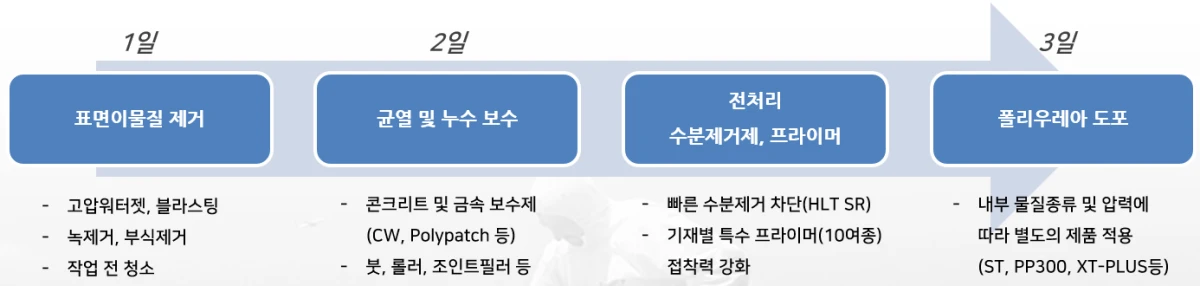
The 4-step process, involving surface preparation, crack and leak repair, pre-treatment, and polyurea application, is carried out over 3 days, from Day 1 to Day 3, based on standard procedures.

01

Surface Contaminant Removal

  • High-pressure waterjet, Blasting
  • Rust removal, corrosion removal
  • Pre-cleaning
02

Crack and Leak Repair

  • Concrete and Metal Repair Materials (CW, Polypatch, etc.)
  • Brush, roller, joint filler, etc.
03

Pre-treatment — Moisture Remover, Primer

  • Rapid Barrier Against Moisture Re-entry (HLT SR)
  • Enhanced adhesion with 10+ types of substrate-specific special primers
04

Polyurea Application

  • Specific products are applied based on the internal material type and pressure (e.g., ST, PP300, XT-PLUS).
Diagram illustrating the 1-3 day application process, from surface contaminant removal and crack/leak repair to pre-treatment and polyurea application.
MATERIAL COMPARISON

How do lining materials compare?

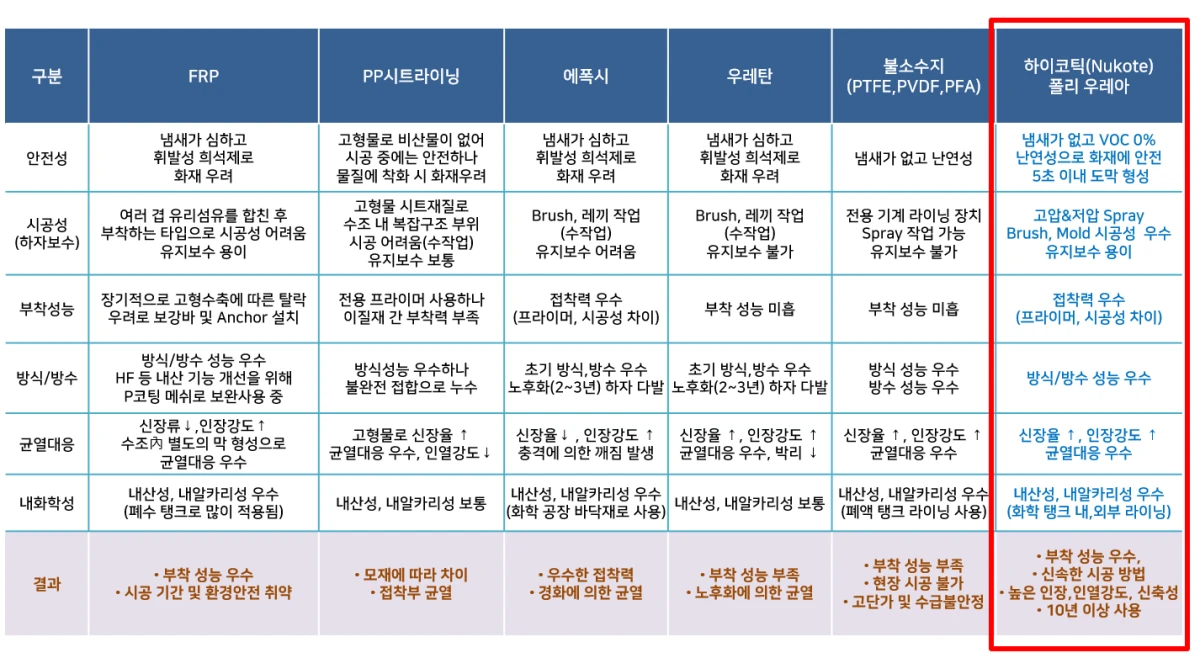
We compared FRP, PP sheet lining, epoxy, urethane, fluororesin, and HIGHCOATIC (Nukote) polyurea based on safety, ease of application, adhesion performance, and chemical resistance.

Lining Material Comparison: Safety, Installability, Adhesion Performance, Corrosion Protection & Waterproofing, Crack Resistance, Chemical Resistance
Category FRP PP Sheet Lining Epoxy Urethane Fluororesin (PTFE, PVDF, PFA) HIGHCOATIC (Nukote) Polyurea
Safety Strong odor and fire hazard due to volatile diluents Being a solid, it generates no airborne particles, ensuring safety during application. However, ignition of the material poses a fire hazard. Strong odor and fire hazard due to volatile diluents Strong odor and fire hazard due to volatile diluents Odorless and Flame Retardant Odorless, 0% VOCs, flame retardant for fire safety, and film formation in under 5 seconds.
Workability (Repairability) This application method involves combining and attaching multiple layers of fiberglass. It is challenging to install but offers easy maintenance. Challenging application of solid sheet materials to complex structures within tanks (manual work required); moderate maintenance. Brush, Manual Trowel/Squeegee Application, Maintenance Difficulties Brush, Manual Trowel Application, Not Maintainable Spray application possible with dedicated mechanical lining equipment, maintenance-free. Superior for high-pressure & low-pressure spray, brush, and mold application, with easy maintenance
Adhesion Performance Installation of reinforcement bars and anchors due to concerns about long-term detachment caused by solid shrinkage Insufficient adhesion between dissimilar materials, even with a dedicated primer. Excellent adhesion (distinct primer and application properties) Insufficient Adhesion Performance Insufficient Adhesion Performance Excellent adhesion (distinct primer and application properties)
Anti-corrosion / Waterproofing Offering excellent corrosion and waterproofing performance, it is currently supplemented with P-coated mesh to enhance acid resistance, including against HF. Excellent anti-corrosion performance, but leakage due to incomplete joints. Excellent initial corrosion protection and waterproofing, but frequent defects occur due to aging within 2-3 years. Excellent initial corrosion protection and waterproofing, but frequent defects occur due to aging within 2-3 years. Superior corrosion resistance, excellent waterproofing Excellent anti-corrosion and waterproofing performance
Crack Response Reduced elongation, increased tensile strength. Forms a distinct membrane within water tanks for superior crack resistance. Increased elongation with solids content for excellent crack resistance, lower tear strength. Lower elongation, higher tensile strength; prone to cracking from impact. Enhanced elongation, increased tensile strength, superior crack resistance, minimized delamination. Increased Elongation and Tensile Strength, Excellent Crack Resistance Increased Elongation and Tensile Strength, Excellent Crack Resistance
Chemical Resistance Superior acid and alkali resistance (often applied in wastewater tanks) Moderate acid and alkali resistance Excellent acid and alkali resistance (Used as flooring material in chemical plants) Moderate acid and alkali resistance Excellent acid and alkali resistance (used for waste liquid tank lining) Excellent acid and alkali resistance (for internal/external lining of chemical tanks)
Result Excellent adhesion performance / Limitations in installation duration and environmental safety Variation depending on the substrate / Cracking at the bond line Excellent Adhesion / Cracking Due to Curing Poor adhesion / Cracks due to aging Poor adhesion performance / On-site application not possible / High cost and unstable supply Superior adhesion, rapid application High tensile and tear strength, flexibility Over 10 years of service life
Comparison Table by Category: FRP, PP Sheet Lining, Epoxy, Urethane, Fluoropolymer, and HIGHCOATIC Nukote Polyurea

A comparison of inherent material properties (Polyurea, Polyurethane, Epoxy, FRP, Polymer cement-based) can be found along with test data on the What is Polyurea page.

FAQ

Frequently Asked Questions about Methods

What is the difference between SIPP and CIPP?

SIPP (Spray-In-Place Pipe) involves directly spraying material inside the pipe using a spray-in-place method to form a coating layer in situ, and is applied to small pipes. CIPP (Cured-In-Place Pipe) involves inserting a liner and then curing it in situ using a cured-in-place method, and is applied to large pipes.

What is the difference between coating and lining?

Conventional coatings typically only create a waterproof and anti-corrosion film 1-2mm thick. HIGHCOATIC's lining, however, is installed with a thickness of 19mm to 51mm, forming a structural body inside the pipe, which effectively creates a new pipe.

What pipe diameters can be rehabilitated?

Unmanned lining is possible for pipes ranging from a small 4-inch diameter up to a maximum of 3 meters. The application is performed by remotely controlling specially manufactured robots from outside, eliminating the need for direct human entry.

Does a trenchless method eliminate the need for road closures?

No excavation is required for pipe replacement, eliminating the need for surrounding area control during installation. Compared to conventional replacement methods, it offers significant social, economic, and time efficiencies.

How many days does the installation take?

The process involves four stages: surface contaminant removal, crack and leak repair, pre-treatment (dehydrator and primer), and polyurea application. According to standard procedures, it is typically completed within 1 to 3 days. This timeline is subject to variation based on site conditions.

Is the lining material safe for potable water pipes?

All products are certified for use in potable water and food facilities by relevant authorities in countries including the United States, Singapore, Canada, and China. They have also received ASTM E84 Class 1 flame spread rating certification. Volatile organic compounds (VOCs) are 0%.

We'll help you review the optimal method for your site.

The optimal method and product vary depending on the pipe diameter, application, and level of deterioration. Please provide us with the drawings and current site conditions, and we will review them and get back to you.